
NOTE: I understand that it’s tough to read these essays in my website’s blog format. I wish I could change the white on black writing for blog pages and leave the rest of this website alone, but it’s just not possible with my WordPress template, so I’ve made this available as a PDF file as well.
Before moving to Los Angeles, I had assumed that, upon landing safely here, my reading habit would be curtailed, if not cut off entirely. This was partly because of the culture—TV and movies really do rule the landscape—and partly because

I wouldn’t be commuting via public transit as often. As a native New Yorker, most of my reading was done on trains and buses.
Happily, instead I’ve found that I’ve been consuming books at my usual voracious rate. Mostly because reading is such a phenomenally enriching way of procrastinating on the writing I have to do. In fact, I would estimate that I’ve probably read a book and a half a week, on average.
(Unfortunately, I just started The Great Escape, Paul Brickhill’s eyewitness account of the massive WWII POW camp escape that formed the basis of the movie of the same name. I can already tell that I will have it finished well before the New Year but too late to make this list, and so I will just give it a plug here.)
The following list does not entirely consist of books published in the past year. In fact, the first book on this list was first published in 1928, and remains long out of print. Also, I could have filled this list with books written by comedians and cartoonists whom I consider friends, but I decided as a whole to leave those alone. I just don’t have time to deal with anyone’s resentments because one friend wants to know why I left them out and picked another person we know instead.
That being said, I will acknowledge my personal relationship with the author of each book as necessary when it comes up. And without further ado, and in no particular order:
-
CLOWNING THROUGH LIFE – Eddie Foy & Alvin F. Harlow – BUY IT HERE
 This is a year that saw me rediscovering the roots of comedy in America, reading, watching video of, and listening to audio of America’s oldest and most forgotten stars. It’s a healthy thing to do, if you care at all about your craft, to show an interest in where you come from and who your pioneers are. Maybe it’s because you can steal wholesale from them, and I’ll talk about that a little more in the entry on Introducing Bert Williams below. Or it’s just as a healthy reminder that as important as you may be, or wish you were currently, you’re nothing more than another name in a continuum of comedy writers and performers, and that as many as came and went before you, there will be as many to come after you as well. Or maybe you just need a reminder that the business is the business, and there’s nothing you’re dealing with that people didn’t have to deal with before.
Most people now remember Eddie Foy as the subject of the Bob Hope film The Seven Little Foys, which, when I was younger, seemed to be on TV one out of every six Sunday afternoons. But there was a time when Eddie Foy was one of America’s pre-eminent comic actors, working his way up from tiny touring companies of long-forgotten plays to one of the biggest stars on Broadway.
Eddie Foy’s book is, like many actors’ autobiographies, filled with exaggerations and tall tales. And yet, he really was there for some of the most formative and interesting episodes of the late nineteenth century and early twentieth (published in 1928, this book was written during the height of the Gilded Age that preceded The Great Depression, and it takes a minute to remember that when he talks about the Great War that young people were sent to fight, he means World War I, which wasn’t even called that back then because World War II hadn’t happened yet.)
Eddie Foy was a young boy when he was caught up in The Great Chicago Fire, and had to carry his baby brother to safety. He was there, onstage on December 1903, for the Iroquois Theatre Fire, which still stands as the deadliest single-building fire in United States history, and whose aftermath ushered in the fire safety codes that we still live by today. He stood onstage and sang to the stampeding audience as the building burned around him, not knowing if his wife and child had made it to safety, in the hopes of calming the maddened crowd.
On occasion, he reaches a thoroughly unbelievable chapter in his life, for instance the two summers he spent as the theatrical toast of Dodge City, befriending Western legends like Doc Holliday and Wild Bill Hickok. When he does, he provides the reader with either proof or, in the case of the aforementioned chapter, a testimonial from a doctor of national renown.
If I have any fault with this book, which is a fantastic read and invaluable window into a world long past, it’s that Eddie Foy is too much a creature of the theater, and perhaps not the best arbiter of what’s interesting and what isn’t. For instance, he gives the reader excruciating detail about his first acting job as a literal spear carrier, while the fact that his mother was Mary Todd Lincoln’s caretaker after the President’s death takes up half of a page.
-
LETTERMAN: THE LAST GIANT OF LATE NIGHT – Jason Zinoman – BUY IT HERE
 I should start this review by acknowledging that, as the official comedy critic of The Failing New York Times, Jason Zinoman occupies a rarified position of power in my little corner of my little world. And I suppose it’s politic to praise his book, but as people who know me best will acknowledge, I’m not a tremendously politic person. The truth is, I’ve stopped being afraid of journalists and the power they wield around the time ten years ago when all the major NYC dailies did their once-a-decade writeup of this crazy “alternative comedy” scene that the kids are into, and all used me as a resource and then cut me out of their coverage, the Times being the most egregious offender. And happily, I no longer carry a resentment over that particular lack of quid pro quo, because I made a decision that I would rather be happy than right. But the truth is that it gave me a broader perspective on what the relationship of an artist and the media should be.
All that being said, Zinoman has written a corker. As a journalist, Jason has the right instincts for researching and telling a story, and as a journalist for the Failing New York Times, he has a degree of access that other would-be Boswells don’t. Thus, he manages to grab a rare sit-down interview with the legendary Dave himself, as well as many many people in his world who normally don’t speak on the record.
I’ve been a fan of David Letterman and his late night talk shows since I was a teen. Since A&E ran daily reruns of Late Night with David Letterman in the afternoon and I was able to pick up on the show from episode one. When you’re young, and you’re angry, and you’re skeptical of the powers-that-be, there is no greater friend than the ornery, ironically detached and scathing Young David Letterman. Refusing to take anything, even his own show, seriously (or at least publicly, as he was famously a perfectionist behind the scenes), he tore down and turned inside out the fabric of show business, and then wore it as a bathrobe.
As he matured, as he grew more successful, his show matured and started attracting the sort of big names that talk shows need, and who need “cool cred” that a talk show like Letterman’s Late Night could afford, and then it changed again when he went to CBS and found himself suddenly one of the Great Old Men of the medium. Towards the end of his run on The Late Show, my favorite segments were when Dave would just speak extemporaneously to the public, talking about something as serious as a blackmail attempt, or as seemingly banal as a day he spent with his son.
So with two books on “The Late Night Wars” and millions of column inches filled about the hosts of late night TV, why is this book necessary? Because J-Zin did the research, and he did talk to as many people as possible, there’s actually much to learn about the reclusive star who shared so much on TV and revealed so little of himself. His early college radio career, the boozy and hilarious first marriage ceremony, the earliest days as a struggling Los Angeles comedian. Zinomensch fills in the areas between public and private person and manages to tell a far more complete story than what we already knew.
-
STICKY FINGERS: THE LIFE AND TIMES OF JANN WENNER AND ROLLING STONE MAGAZINE – Joe Hagan – BUY IT HERE
 If David Letterman was a larger-than-life media personality who desperately guarded his privacy, Rolling Stone’s founding editor Jann Wenner was a behind-the-scenes power broker who sacrificed everything to be a larger-than-life media personality. I knew that I was going to buy this book the first time I read an article about it, in which the author, Joe Hagan, explained that Jann had hired him to slap together a hagiography, and gave him hundreds of hours’ worth of interviews and unrestricted access to his archives. And then Hagan decided that the only ethical way to tell this story would be a warts-and-all biography, stabbing old Jann right in the back. Which is a story that a lot of Rolling Stone subjects can tell, and in this book they certainly get a chance to.
I have nothing against Jann Wenner, personally. As you read in the book, he took every risk and chased every lead to bring his vision of a publication that reflected his generation’s sensibility to life, and to keep it running. As obvious as that concept seems now, back in the 1960s it seemed unthinkable that the world-at-large could support a mainstream newspaper that did in-depth reporting on rock and youth culture, in which that generation’s twin obsessions with copious drug use and loud guitar music were covered with the gravity of Watergate or the Moon landing.
And despite his reputation as a gadfly, he did take this mission seriously. When his former business partner Mick jagger put together a boondoggle of a festival at the Altamont race track, in which the Rolling Stones’ headlining set was punctuated by a riot in which the Hells Angels’ Motorcycle Club beat and murdered their fans, Rolling Stone was merciless and thorough in its coverage of the event, and wasted no time in pinning the blame on Mick personally. And when Hunter S. Thompson filed his landmark gonzo Fear and Loathing political coverage, Wenner gave him a long leash and physically cut and pasted his speed-addled writings into a coherent narrative.
And while the book leaves no doubt that he achieved his goal of being a Very Important Person, it’s similarly unflinching in its look as a man so driven to power that he’s willing to discard friends and lovers and John Lennon. As the Baby Boomers, a generation of self-described idealists, burn out on leftist politics and start craving success and the comfort of material goods (as well as the rush of cocaine), so did Wenner, and so did Rolling Stone.
Joe Hagan is another journalist who knows a thing or two about storytelling, and it shows in his ability to craft a page-turner of a story about, what is in the end, another story of how an old media giant came together and survived bankruptcy both financial and creative.
-
IN SUNLIGHT OR IN SHADOW: STORES INSPIRED BY THE PAINTINGS OF EDWARD HOPPER – edited by Lawrence Block – BUY IT HERE
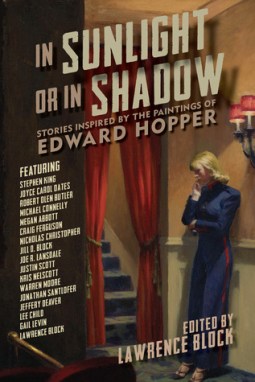 Full disclosure: Not only do I consider Larry a great social media friend, but I’ve talked to him in person and interviewed him on a podcast, and I like him a lot as a real decent dude. He’s also an Edgar Award-winning Grand Master of mystery fiction, and his worst books are still crackerjack fiction that stand with the best of modern detective fiction.
I could recommend a half-dozen of his novels in this space, but instead I’m going to recommend this collection of shorts stories curated from a variety of the greatest American genre fiction writers, inspired by that greatest American painter of narrative fiction Edward Hopper. Who better to serve as a jumping-off point for noir writing than the painter of the ultimate work of noir visual art, the 1942 painting Nighthawks?
And for the effort, Block has assembled a veritable Dirty Dozen of Big Bestselling Names – Stephen King, Joyce Carol Oates, Lee Child, Jeffrey Deaver. And while, as in many themed anthologies of short fiction, the quality varies from piece to piece, there’s enough gold between the covers to make the book more than worthwhile.
Jesus Christ, that last sentence sounds like something from the desk of a publishing company’s PR department, doesn’t it? It’s true, though.
-
INTRODUCING BERT WILLIAMS: BURNT CORK, BROADWAY, AND THE STORY OF AMERICA’S FIRST BLACK STAR – Camille F. Forbes – BUY IT HERE
 Entering that continuum of performers who were once the brightest-shining stars in the world, and are now mostly forgotten, I had known Bert Williams for many years as a name, a vague reference, more than anything else. The first black comedy superstar in the United States, arguably the first black celebrity, and a headliner in vaudeville back when that meant everything. And as usual with things that you “know” from having absorbed them second-hand, that was only scratching the surface.
In Camille F. Forbes’ fantastic biography, we begin at the earliest medicine shows, where a young light-skinned boy Bert Williams got his start, barking customers in. (Medicine shows were traveling revues, a proto-vaudeville circuit, where admission was free, and pitchmen would sell their dubious medicines between acts.) From there, the shy Williams graduated to minstrel shows, where he learned to conquer stage fright by donning blackface.
A lot of comedians will that the only way to get comfortable onstage is to wear a mask of one kind or another. If you’re up there speaking honestly about your fears, your neuroses, your hangups, there’s a better-than-average likelihood that people in the audience will judge you, even hate you. So, as I say, many comedians put on a mask of sorts; an attitude, or a character who says the things you secretly think but never expected to hear spoken aloud in polite society, a costume or a style. Anything that creates a protective barrier between the fragile performer’s ego and the barbarian horde of strangers in the audience.
Blackface went out of fashion relatively quickly among most audiences and performers of all races as an embarrassing relic of a better-forgotten recent past, but Bert Williams wore it all the way to the end of his career, by which time he was a star of enough magnitude that there was no succumbing to the pressure among his peers to change.
Young Bert wound up partnering up with the crusading, pioneering African-American performer/producer George Walker, who pushed the duo’s business prospects from touring headliners to the first stars of the first all-black production on Broadway. Success followed success for the duo, and when Walker succumbed to a stroke at a young age, Williams found new stardom as a solo, eventually headlining the immortal Ziegfield Follies.
These are the bare bones of the story, and a fine enough read on their own. What Forbes does is paint a broader picture of the world of pre-war, pre-Depression Broadway and show business, and provide a look at not only Williams’ successes, but the petty, daily indignities he suffered as a result of those successes. The hotels where, if he was allowed to enter at all, it was only through the maintenance elevators. The loneliness of being a major African-American in the mostly-white business of vaudeville. The constant humiliating treatment by performers of lesser talent and stature. The notorious White Rats vaudeville union.
Add into this an in-depth look at Williams and Walker’s musical comedies, the founding of the African American Frogs club as an alternative to the all-white theatrical clubs and associations from which this newly-rising affluent class of artists were being excluded. Their wealthiest members relegated to the balconies to watch the latest Williams and Walker play.
The work of Williams and Walker was all new to me, and Forbes is to be commended for – well, not quite re-discovering these works, because they had never been lost. It’s just that they had never been filmed for posterity, the technology obviously not existing to do so. But it’s tough to breathe new life into the musty old works of the Golden Age of Broadway, mostly because there’s so much context to be created for appreciating them. This Forbes has done wonderfully.
If I had one complaint, it’s that Ms. Forbes appreciates that the fact that Williams and Walker were, by being successful and famous actors and businessmen in a time when Jim Crow was not only the law of the land but also a hugely popular style of songwriting, in themselves a political and social statement. But she has in this book devoted pages to explaining plainly and repetitively the importance and impact of who these men were, to the point where I stopped reading and said to myself, “She must be an academic.” Sure enough, flipping to her bio on the back flap she is a professor at a university in San Diego. This is just a personal pet peeve, as someone who feels that it’s too easy to analyze and pick apart the alleged political implications of standup comedy.
But that’s a minor quibble for such a thoroughly engaging and well-written biography of a man who is considered by many today to be a footnote, when he’s considered at all. Although i was delighted to learn, through reading transcripts of Williams’ solo monologues, that Richard Pryor had lifted huge chunks of the Bert Williams monologues wholesale for his classic album …Is It Something I Said?, particularly the Mudbone monologue interlude. As I say, we in the business of comedy stand on the shoulders of giants who stand on the ruins of statues of giants.
Of all the books I read this year, this is the one that I find myself thinking about again and again.
-
HARPO SPEAKS – Harpo Marx and Rowland Barber – BUY IT HERE
 If you had a chance to read this when you were young, as many of my friends did, then just know that I envy you. Halfway through reading this autobiography of the “dumb” Marx Brother, I realized that I was breathlessly falling in love with a book about a man who had been dead long before I was born.
I’ve been a fan of the Marx Brothers since I was a wee lad, watching their movies with my grandfather a huge fan and, like the brothers, a Jewish native New Yorker (although of course about forty years younger). For a while when I was young, their movies came on PBS late at night, and the tapes I made on our huge, $400 state-of-the-art VCR, were treasured by me until I finally, reluctantly, had to throw them out last year.
And while I knew a lot about the Marx Brothers and their career, and I knew some about Harpo having read about him through essays and reminiscences of his friends in the Algonquin Round Table, and his brother Groucho’s biographies and autobiographical writings, I was embarrassed to learn that still I knew maybe a quarter of the story.
The book begins with Harpo’s hardscrabble beginnings at the end of the 1800s, when New York City was all unpaved roads and cobblestone, and the Upper East Side was still a shtetl. His mother, the great Minnie Marx, is portrayed as an evangelical preacher sort of character, someone who one would believe almost literally heard the voice of God tell her that her children belonged in show business.
The book takes us into the lowest depths of professional touring vaudeville (and those were some deep troughs, that forged a performer’s desire to commit to a life of show business or quit and lead a life of guaranteed meals and income), to the brothers’ natural evolution from a singing child act who channeled their untameable creative energy as adolescent cutups into a professionally unprofessional comedy act.
Harpo’s stage character was that of a childlike naïf with no voice who sometimes does the wrong thing, but only because he really didn’t know any better. And the real-life Harpo portrays himself as a similar character in this book, floating from stage success to friendship with the most powerful newspaper critic in New York City, the mercurial and fascinating Alexander Woolcott. From there he seems to drift into a friendship with the era’s greatest playwrights and authors, and through all sorts of adventures, including a successful run in the newly-formed Soviet Union.
if the character seems a bit unbelievably Chauncey Gardiner-esque, and if some of the anecdotes seem a bit too on-the-nose for how they wrap up neatly in a punchline-driven bow, you are able to forgive Harpo, being not only such warm and wonderful company as a storyteller, but also for being a genuine national treasure and part of one of the greatest comedy teams that ever escaped vaudeville and early Broadway and into immortality.
-
NO MUD NO LOTUS: THE ART OF TRANSFORMING SUFFERING – Thich Nhat Hanh – BUY IT HERE
 I think it’s inevitable that, when you move to Southern California, especially into Los Angeles, you begin to embrace philosophy, and meditation, and looking within. Perhaps it’s because you’ve reached the end of the classic journey of American expansion, and you’ve moved westward and westward until the only options are to either push west and drown in the Pacific Ocean, or to push further within.
Or perhaps it’s the first time you sit on a beach and watch the beauty that is the sun setting over that Pacific Ocean, and you suspect that there’s more to this world than you believed possible. Or maybe it’s because LA makes it easy to make a lifestyle out of sitting alone in your apartment smoking weed and thinking about yourself a lot.
In any case, in the city that spawned a thousand cults, I sat and on the suggestion of friends, read a few books on Eastern philosophy. And through that reading I stumbled on this work by Thich Nhat Hanh, a 91 year-old Buddhist monk, author, and activist.
Through a combination of breathing exercises, meditations, and a little bit of self-help wisdom, Nanh espouses a simple but enticing philosophy: that in order to transcend suffering into happiness, we can’t shy away from this suffering but rather embrace it, recognize what lies at its roots, and learn to live within it. After all, just as there would be no beautiful lotus flower if there was no mud in which it could blossom, so your life would have no true joy if it had no sorrow with which to compare it. Or as Butthead (of Beavis and Butthead) puts it, “You’ve got to have stuff that sucks in order to have stuff that’s cool.”
It’s an appealingly simple and easy-to-grasp philosophy, and if seems one of those “Well of course, it’s obvious when you put it that way” ideas, well, guess what? If you had put it that way, I’d be writing about your book on the Zen way of deconstructing the pain and trauma that comes with being alive in this wicked world of sin and suffering.
I’m not necessarily saying it provides enough meat on its own to make an intellectual banquet, but few books on philosophy and self-help do. But there’s enough here to make a fine stew, and that’s better than most.
-
IN GOD WE TRUST… ALL OTHERS PAY CASH – Jean Shepherd – BUY IT HERE
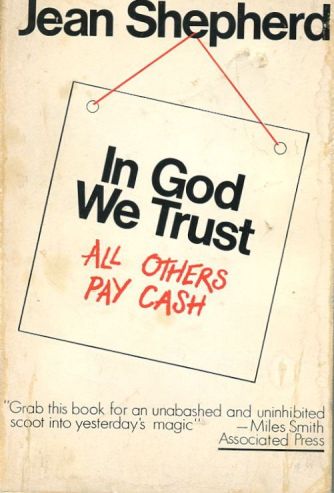 When I was a kid, I had two major exposures to Jean Shepherd:
For some reason, maybe they owned a copy of the print, maybe the studio paid them to do this, but for at least a couple of years, the Loews Elmwood theatre in my neighborhood would have a free Christmas Day screening of Jean Shepherd’s now-classic film A Christmas Story. This was back when VHS copies of tapes were relatively expensive, and way back in the dark ages before the thousands of cable channels and dozens of movie screening sites made watching whatever you want whenever you want a lifestyle.
Cable TV gets all the credit for cementing the film’s status as a classic, but long before TBS went national, my best friend James and I knew all the dialogue by heart and would shout it back and forth to each other through the slicing winds of the cold grey Queens winters. Of course, this movie was loosely based on Shepherd’s autobiographical writings of his childhood in Depression-era Indiana, a time and a place that was as exotic to little me as Edwardian England, or Medieval Japan.
My second exposure: When my parents told me who Jean Shepherd was, and that this movie that I loved so much was actually based on one of his books, I was mad to read his work. (Incidentally, this is how I came to Sherlock Holmes, after I went with my sister to see Young Sherlock Holmes for her birthday.) The only Shepherd book my parents had at the time was a much-loved copy of Wanda Hickey’s Night of Golden Memories and Other Disasters.
I loved Wanda Hickey and read it front-to-cover. But something in me as a young child understood that as funny as it was—and it still stands as one of the funniest books I’ve read—and that might be a fun list to tackle some day—it also had a much heavier, much less whimsical tone than A Christmas Story, and so I left this book alone, so as not to ruin the thing I loved.
As an adult tackling In God We Trust…, I recognize how right on my instincts were. Jean Shepherd was a crotchety old grouch, which is one of the reasons his stories are so great. It’s not so much that he sees clearly enough that it cuts through the mists of childhood nostalgia so much as he’s enough of a cynic to recognize the cheap magic trick those memories can be. Hence his descriptions of an event as wondrous in childhood memory as his father saving up his salary to take the kids to the annual county fair are grandiose and wide-eyed as only a child could see them, while also being as world-weary and cynical as only someone who had been disappointed time and again by the world as an adult can be.
And yet, as cutting as he was, there was an affection to it all. When he looks back at himself as a “dumb little kid,” it’s with a rueful half-smile.
His whimsy is both sincerely-lived and hollowly-mocking, and while, as I can appreciate the mordant humor, a part of me will always appreciate the job that Bob Clark (the director of the film) did in dulling the razors and allowing a little more light and joy into the story.
-
KILL THE GRINGO: THE LIFE OF JACK VAUGHN, AMERICAN DIPLOMAT, DIRECTOR OF THE PEACE CORPS, US AMBASSADOR TO COLOMBIA, AND CONSERVATIONIST – Jack Hood Vaughn – BUY IT HERE
 Again, I have to be honest here. I would probably not have picked up this book if Vaughn wasn’t the father of a friend. Local libraries are filled with the autobiographies of career army officers and local elected officials and you always think you’re going to find a rare gem in these books and you never do. But if that’s a rule, then Kill the Gringo is that rare exception; a book by a relatively-unknown figure that is in turns exciting and insightful.
And Vaughn can be said to have led an interesting life, to say the least. As the man who took Sargent Shriver’s place as the head of the Peace Corps (and before he ever made Lieutenant AH HA HA HA HA excuse me while I put that gem into my Smothers Brothers submission packet), and then the ambassador to Panama and Colombia, Vaughn can certainly be said to have lived every second of his life.
These kinds of memoirs tend to make me feel bad about the relatively little I’ve done, until I remember that they never include long stretches of, say, unemployment when the author decided to just take a couple weeks to himself and watch The Price Is Right while he gets his head together. But the story of his Peace Corps years are an extraordinary read (I still suspect the CIA was involved with the Peace Corps, but the former head definitively states that’s wrong, so who am I to deny it?), and an actually interesting and new look at an era that can sometimes feel as if it’s been written about to death in journalism, literature, film, and song.
And before 2017 and Twitter, how many people could tell you a story about getting yelled at by a sitting President?
-
DOWN AND DIRTY PICTURES: MIRAMAX, SUNDANCE, AND THE RISE OF INDEPENDENT FILM – Peter Biskind – BUY IT HERE
 Peter Biskind is an extraordinary and tireless chronicler of the Greats of Hollywood, from his seminal look at American New Wave cinema of the ’70s Easy Riders and Raging Bulls to a book he edited, My Lunches With Orson, a series of rambling conversations between Orson Welles and Henry Jaglom.
As more and more news of Weinstein’s alleged monstrousness has come out, harassing, assaulting, raping, coercing, and silencing some of the most famous women in Hollywood, this book, which I read back in January, keeps coming to mind. In it we learn about indie cinema and its two fathers – the (as portrayed in this book) dithering cipher Robert Redford, whose Sundance Institute initially champions deliberately uncommercial works by outsider auteurs, and whose film festival becomes, almost against every instinct of the people who run it, a marketplace for the newest and most interesting voices in American cinema of the ‘90s.
And on the other hand you have the Weinstein Brothers from Queens. And why do all the monsters of 2017 have to be from Queens, my own homeland? Crass, rude, and lacking formal film education, the Weinsteins have PT Barnum’s instinct for showmanship and Sam Goldwyn’s brutal appreciation for the bottom line over all.
The world has become acquainted with Harvey Weinstein, Sexual Predator, but readers of this book, and really anyone who was in the film business starting in the early-to-mid ‘90s, got to know Harvey Weinstein, The Large Predatory Animal. This book portrays Miramax as a shop where the best and brightest young stars of the cinema went to learn their trade, to make the kinds of films they’d always dreamt of making, and to watch that film get taken from them and cut and cut until it fit the vision that Weinsten, an aspiring filmmaker himself, had in his head.
And this book is full of stories of violence, of fistfights, of going to war in every sense and in every avenue, and of having the results—Oscar after Oscar—to make his methods, if not palatable, at least something that the rest of the film business could turn their heads from. The Weinsteins who not only gave the world Quentin Tarantino and Kevin Smith, but also the modern concept of the the Oscar marketing Campaign, placing ads and sending freebies to academy members. The Weinsteins, who discovered and championed some of the greats of the late 20th Century, and bullied and abused them at every turn.
While the Sundance stuff is interesting, and Biskind takes us down some avenues and reminders of where the ‘90s Indie Cinema movement succeeded and also how it failed, it was, even before the #metoo movement took steam, Harvey Weinstein that dominated this narrative for better and for worse. In fact, the book begins with an autobiographical interlude, in which Biskind is summoned to the Miramax office and run through the Weinstein Brother Wringer: First he’s threatened, then he’s flattered, then he’s bribed with a too-good-to-be-true publishing deal with Miramar Books.
All in all, it’s a fascinating look at a period of American cinema, as told by the winners and, even more entertainingly, by the losers. A period whose story is still recent enough that very few critics are taking the kind of perspective on it to give it an overview that Biskind does. Still and all, with all that we’ve learned about the players in this book this year, I’d love to get an updated edition with all the stuff Biskind couldn’t or wouldn’t print before.
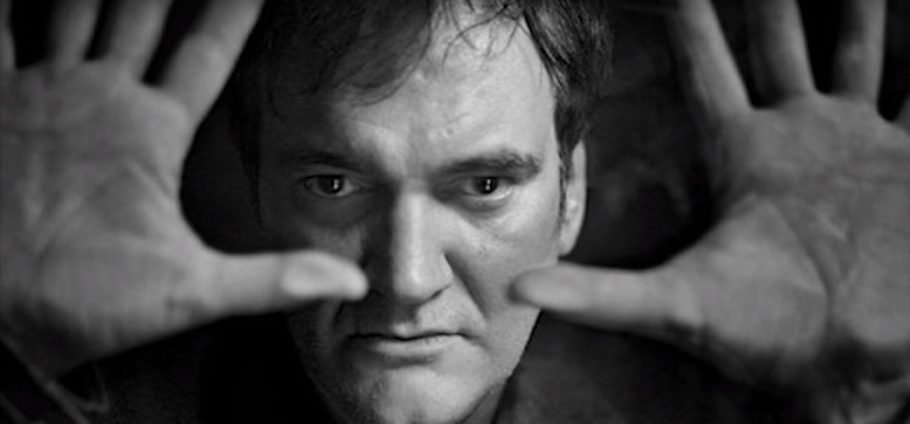
 And, so: The Star Trek nerds of the Internet are become outraged. A story broke that, in addition to the upcoming film that he’s announced about the Manson Family murders,
  And so. Tarantino’s characters scurry and scutter like cockroaches in the shadow that pools like blood beneath the green trees and white picket fences world of that dream. In the projectionist/revolutionary-cum-revenge killer of Inglorious Basterds, in the unseen and shadowy mastermind Bill of Kill Bill, in the seedy drifters and petty criminals of Jackie Brown, the late Charlie Manson would have found plenty of happy company in Tarantino’s movies.
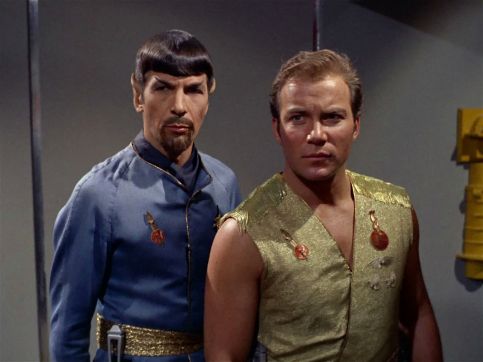
 Star Trek’s characters may be men and women of action—or in the case of The Next Generation, men and women prone to endlessly debating and discussing, like a Jewish family at the Olive Garden for the first time, examining the menu—but their actions are grounded in sharply-drawn laws, directives, and codes of conduct. By the laws of the Federation of Planets, the directives of Starfleet that govern everything from dress code to protocol on encountering new species and traveling through time. Some of Captain James Kirk’s biggest struggles are the moral ones between what’s “right” for the crew that his captaincy makes him responsible for, and what’s “right” for the beings he encounters, and what’s “right” as defined by the iron-clad laws of the world in which he lives.
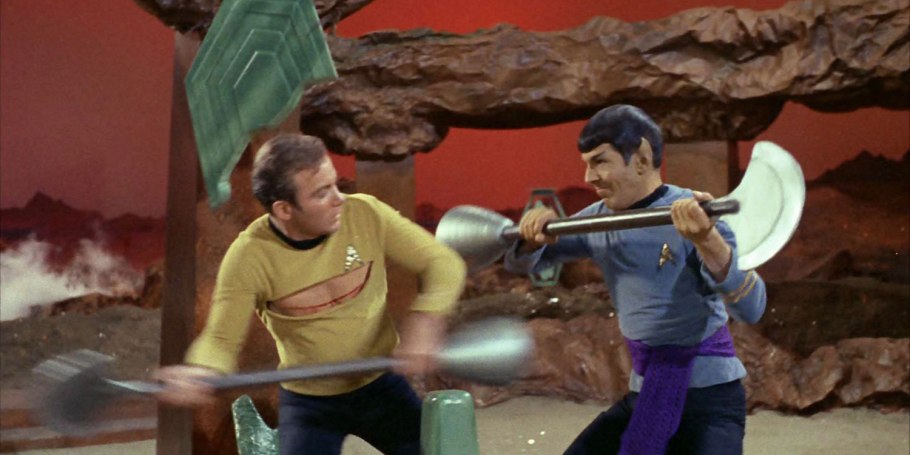
 After all, in Pulp Fiction, it’s only after John Travolta’s hitman clearly decides that he is going to sleep with his boss, Marcellus Wallace’s wife, and after she decides to sleep with him, that she accidentally overdoses on heroin and Travolta’s Vincent Vega must save her life or surely be murdered by Wallace in return.
 Star Wars is a film series that values spectacle over all, with much less concern for interpersonal relationships except in the grandest terms; it’s a world of gigantic oedipal stories told with gigantic mythic archetypes. It’s telling that of all the characters, the most consistently relatable is Han Solo, the cocky pilot who gets in over his head constantly, who fails consistently, and whose heroism lies in overcoming his own limitations.
 The strength of Star Trek lies in its relationships, and not just between the characters, but even more importantly, between the show itself and the fans. Before the Internet broke down the walls between popular and outsider art, there were many examples of music, TV, movies, that were initially designed for mass-market consumption, but was such a product of personal vision that it found itself the object of a niche, or “cult,” audience. A group of fans for whom part of the joy of watching a show, or reading a book, or
 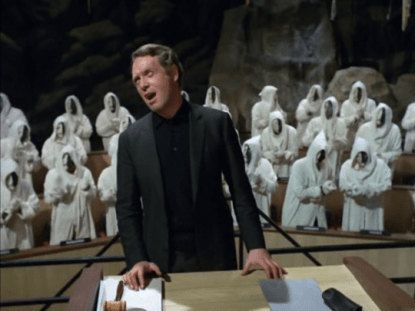 I carried The Official Prisoner Companion around my junior high school for three months, hoping a cute girl would notice and tell me that she thought I was super cool. Shocking twist ending: Never happened. But in the back was a guide to all of the various Prisoner fan groups you could belong to, and so as a 12th birthday present, my parents subscribed me to the cheapest one (six bucks for six months, I think). Every month or so I would receive a hand-Xeroxed, hand-stapled fanzine, with stories and baffling comics written by fellow fans. It was a thrilling peek into a world where people obsessed over all the same things I did.
 I’ve stopped going to conventions. They give me panic attacks. The convention floors is packed with packed with young people in costume, having found a way to keep the Halloween party going beyond the full week out of the year it’s allotted in most cities now. The sounds and the music and the lights and the overwhelming melancholy I feel knowing that the world I once knew is gone.
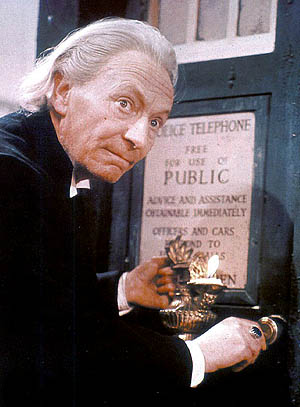 So why do we keep circling around these things over and over? Why is our culture incapable of creating new beloved myths? Is it because they still speak to us, or is it because they made us a feel a certain way once upon a time, and we as a people are trying to recapture the magic of that first fandom? When I watch, when I support, these things, am I holding on to something I love, or am I having trouble letting go of who I once was?
 Liam McEneaney: Comedian, Writer, Producer